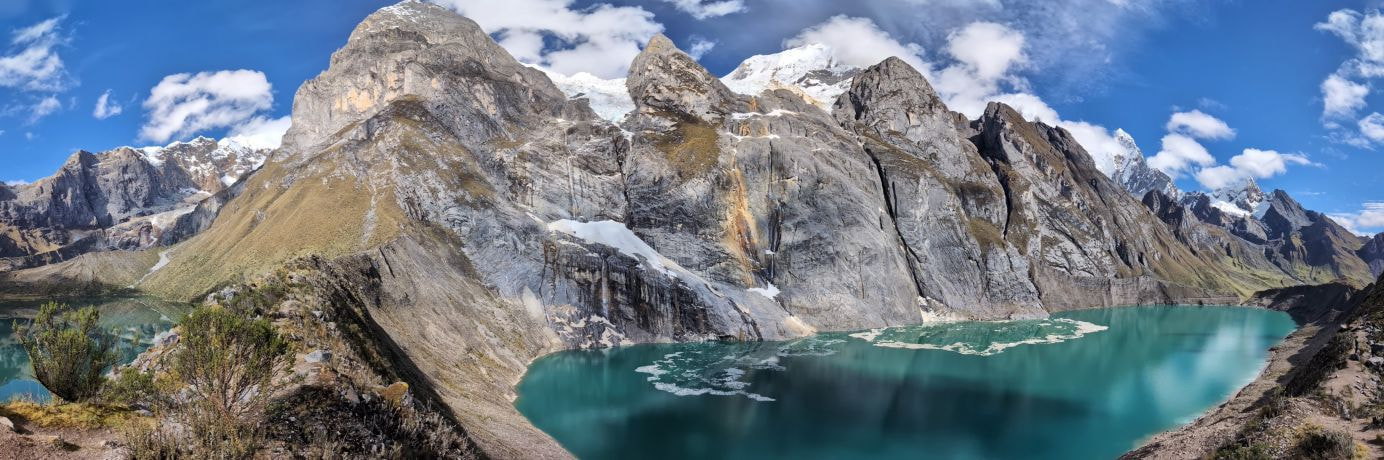
We loved our first trip to Peru so much that we decided to make a second and were not disappointed! Huaraz was much less touristy than Cusco, which means you can relax in the main square without getting harassed and a you will have to rely on your Spanish skills a bit more to get around. The area has limited ancient architectural sites but make up for that with mountains that are so much more dramatic than anything Salkantay or the Inca Trail have to offer!
The grandeur of these mountains comes at a cost. Forget about manicured ancient roads, these are real rugged mountain passes and they make you work for it. If early mornings, hot/cold temperature extremes, daily rainy or snow, and rough terrain aren’t to your taste, this trek may not be for you. We hike and backpack hundreds of miles a year in the Cascade Mountains and there where places that pushed our comfort zone, but there milder options.
We had a really awesome experience with our guide Darwin and in 2026 he is starting his own agency: https://www.trapecioadventure.com/index.php
This article is partially done but still in process, so please stop back or follow our Facebook page to make sure you don’t miss anything.
Adventure Guide
- Trail Details & Tips
- How To, Options, & Acclimatization
- Campsites & Amenities
- Our Adventure (with milage & elevation)
- Packing List
Trail Details
- Moderate to Hard Trail Options
- All options require altitude acclimatization
- Can be done year round but best time to visit is May-August
- Bathroom at camps only
- Wifi for a fee at 2 camps
Hazards
- Altitude sickness (can be life threatening)
- Some trail sections are narrow, slippery, and/or rocky
- The trail is often unclear
- Heat & cold including snow storms
- Some stream crossings
- Wildlife, dogs, and farm animals
- Cow, horse, and donkey poop
- Sun exposure
- Stinging plants
Tips & Things to Know
-
Head Lights: Each camp provides a toilet but there is no lighting, so headlights are essential for doing your business. A flashlight could work but I would not recommend it. A headlight with a red light setting is ideal because it allows your eyes to adjust to the dark better for star gazing and is easier on the eyes for your fellow campers/sleepers.
-
Waterproof Socks & Sandals: It is really nice to take off your boots at the end of a long day but the nights are very cold, often wet, and the camps are prone to marshy sections where you can unintentionally submerge your feet. We like to wear slip on sandals and waterproof socks over liner socks so we can easily get in and out of the tent and keep our feet warm and dry. We take the waterproof socks off before getting in our sleeping bag to keep everything clean.
-
Waterproof Luggage: Some companies provide duffles for you gear and some don’t. Be sure to check ahead of time and bring an extra large trash bag in case you need an extra layer of protection inside you bag. Better safe than a wet sleeping bag! It is a good idea to bring some extra plastic bags too.
-
Ear Plugs: Campsites can be noisy and you never know when you will end up next to the party group or the group starting at 4AM, so ear plugs are a good precaution.
-
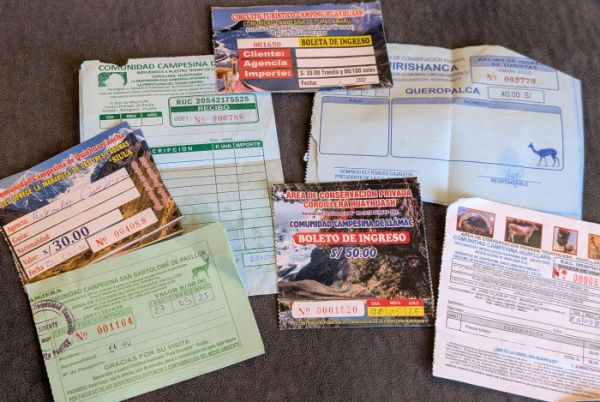
Cash: You will Peruvian Soles in small bills for camp fees (in 2025 not in order - 30, 20, 50, 30, 40, 50, & 30 PEN), anything you want to buy along the way, and tips if you use a trekking company. You can get small bills in Huaraz at exchange counters. The ones in the main square were happy to break large bills for us even though we did not exchange money there.
-
Sun Protection: The sun is intense and there is very little shade at altitude, so in addition to a good sunscreen and chap stick, we highly recommend protective clothing, like hats, sunglasses, and hooded sun shirts (hers/his).
-
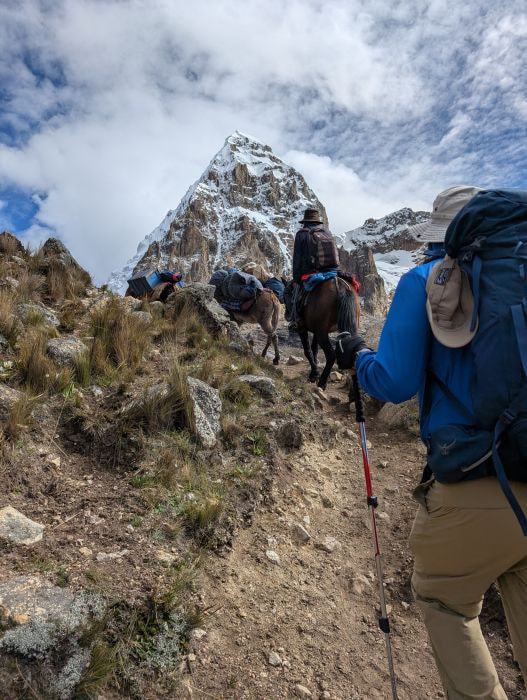
Donkeys & Livestock: Many of these trails are shared with livestock, and these animal poop, so there will be poop on the trail and in camp. It is impossible to avoid it, so just be aware and plan on washing everything afterwards. You are also likely to encounter the donkey trains and while they are cute gentle animals, they are generally not spatially aware of their luggage. It is safest to move out of the way when they pass and give them a good amount of space. I’ve been hit by them before on other trips and it isn’t fun.
-
Toilets: Toilets are typically only available at camps and those typically don’t have toilet seats (not a big deal but something that might surprise some people). In between, people just go in the bushes. Ladies - A Kula pee cloth is a great environmentally friendly and convenient alternative to toilet paper.
-
Early Mornings: Due to the weather, early morning starts were essential. We used our watches to set an alarm because they are much more power efficient and reliable than phones.
How To & Options
You can just show up and do this independently, and people do, but most people do this assisted.
All Inclusive, Assisted, or Independent?
-
Some companies offer “all inclusive” packages for the entire trip to Peru, but most are just for the trek portion. Most tours pick you up from your hotel in Huaraz, cook all the meals on the trek, provide drinking water, a guide, and transport your gear from camp to camp. Many provide tents and rent additional gear, like sleeping bags. A few companies handle the hiking and camp fees, but most just advise you of what they will be and require each individual to pay them. These tours can be arranged ahead of time or booked in person in Huaraz (only recommended if you have a flexible schedule). We had a really awesome experience with our guide Darwin and in 2026 he is starting his own agency: https://www.trapecioadventure.com/index.php
-
We saw a few groups with some kind of assisted setup where they might just have gear transportation or just had a guide. We didn’t see any of these advertized, so I assume this is something that their group negotiated.
-
There were a few independent backpackers on the trail and this is doable, but you need to either live at high altitude or have at least an extra week or two to fully acclimatize. You will also need to work out transportation logistics and food (dehydrated and freeze dried food is hard to find in Peru). I would advise doing your research ahead of time, but also checking your plan with someone in Huaraz and staying flexible because camps open and close, trails get rerouted, and many paths that appear to be trails are actually cow paths.
How Many Days?
This really depend on the route and the pace you prefer. The “full circuit” has infintie variations, but can be done in anywhere from about 6 to 12 days. 8 days is a pretty strenuous itinerary which is the fastest most standard tours offer. 10 to 12 days is more common and some versions include a rest day. There are also short tours where you only do a portion of the circuit and some even include hot springs. Be careful, some people are just trying to sell tours, while others will ask a lot of questions to see what the best fit is.
Private or Group?
Such a hard question! We love meeting people and swapping stories, but joining a group often means group decisions and group pressure. I am always scared to be the slow person in the group or the one that doesn’t feel good and prevents the group from making it to the viewpoint. I haven’t been that person yet, but I have been in groups on other trips where that has happened. If you do a private trip you have a lot more control, but less company.
What Route?
This is where a good guide can really help. Below is the route we did, but most nights our guide would pull out the map, show us the options, and let us pick. During the day, if the weather was good, they would often offer us additional optional viewpoints. Some days our group split and part of our group would do a more relaxed route.
Acclimatization!
We can’t stress enough how important this is! Altitude can make you really sick and even be life threatening, so regardless of you age, fitness level, or previous experience, you body needs time to adjust. Most people need a minimum of 3-4 days in Huaraz, taking day trips to higher altitudes, for an assisted trek and much longer for unassisted. There are ton of options in Huaraz for day trip and a guide can make recommendations, but this is what we did:
-
Day 1: Flew into Hauraz and had a rest day with some exploring on foot around the city. We also used this day to arrange our day trips and pick up food/water for hiking.
-
Day 2: Hiked to Lake Wilcacocha. We took a taxi to the trailhead just outside of town and took a colectivo back (small change required). You can take a colectivo both ways, but you will need to figure out where to find them and what number/letter to look for. The tourist information center in the main square may be able to help with this. The hike is not very well marked so a gps track would be very helpful. This hike passes through farmland and is a fun mix of rural life and mountain views. Views are typically best in the morning.
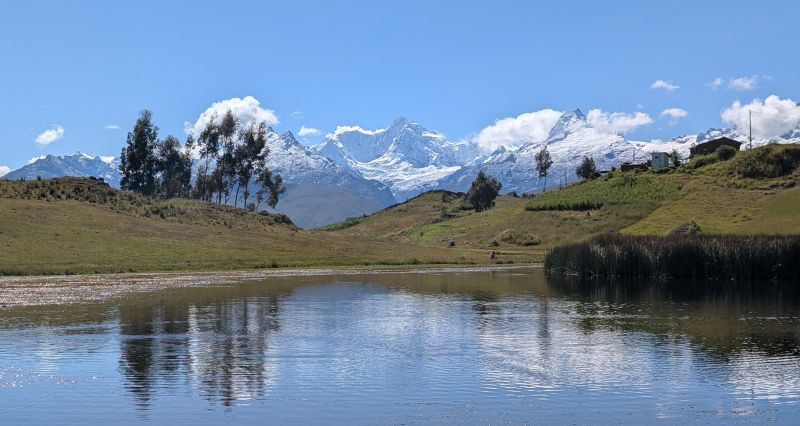
- Day 3: Hiked to Leguna Churup. We got to the agency early to secure seats on an organized shuttle van up into the mountains and a 20 PEN ticket covered both trips. We also paid the park entry fee at a guard building partway up the trail (as on 2025 the fee was per person - 30 PEN for a day, 60 PEN for 3 days, or 150 PEN for a month). This trail has an option between a way that is steep with minor scrambling and a steeper way with ropes. Both ways can have ice so be careful.

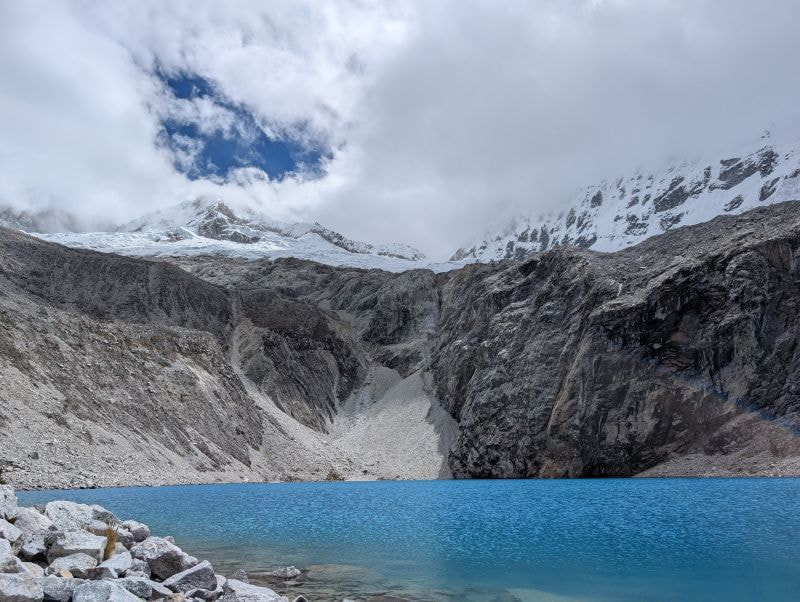
- Day 4: Hiked to Laguna 69. This is a long full day trip and can be done via private tour or a group bus (about 20 USD in 2025). You wil be required to buy or already have the same pass as Churup at the park entrance(as on 2025 the fee was per person - 30 PEN for a day, 60 PEN for 3 days, or 150 PEN for a month). Most hotels and hostels can help arrange a bus and there are many different agencies. Most group buses are coach style buses with reclining seats. They pick you up, stop at a place where you can buy breakfast and lunch, drop you at the trailhead, then you can hike independently, and they take everyone back at a set time. There is typically a “guide” who may or may not speak english and is there for safety and logistics to make sure everyone knows where to go and makes it back.
-Acetazolamide (Diamox) can help avoid serious consequences of altitude, but is not a substitute for time. This medication impacts different people differently and can have its own adverse side effects.
Campsites & Amenities
Camp 1:
- Approximate Location: -10.18052, -76.89063
- Altitude: 4260 m / 14,000 ft
- Views: Excellent!
- Toilets: 4 flush toilets & a water spigot
- Animals: Livestock in camp
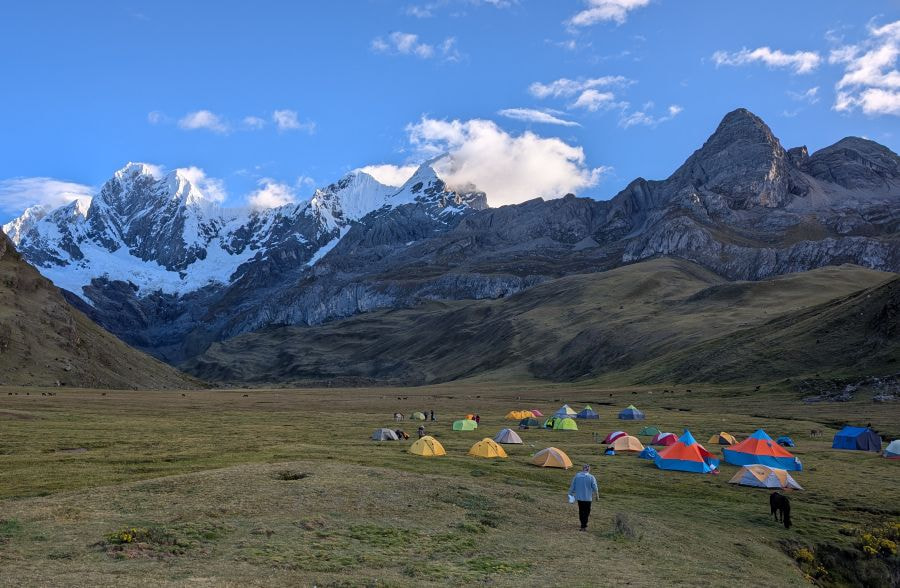
This camp was very picturesque and had a stream for some white noise but had surprise boggy sections. Even during the day the ground looked fairly normal but when you stepped on it your foot would sink into the water/mud at least a couple of inches deep.
Camp 2:
- Approximate Location: -10.24093, -76.86206
- Altitude: 4200 m / 13,800 ft
- Views: Unbeatable reflections!
- Toilets: 4 flush toilets & a cold water sink
- Animals: No livestock in camp
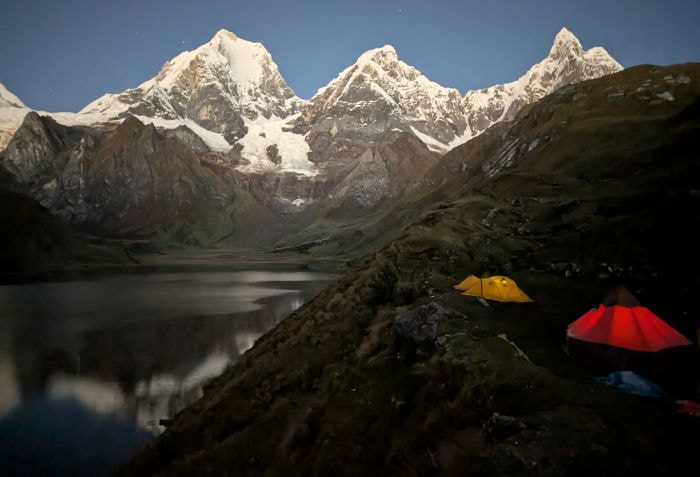
Our favorite camp! This camp featured a stunning locations and had multiple camps, which spread people out making it peaceful. We were told that the camp can be wet, but it wasn’t while we were there.
Camp 3:
- Approximate Location: -10.32774, -76.84287
- Altitude: 4360 m / 14,300 ft
- Views: Nice in multiple directions
- Toilets: 4 flush toilets & 2 cold water sinks
- Animals: No livestock in camp
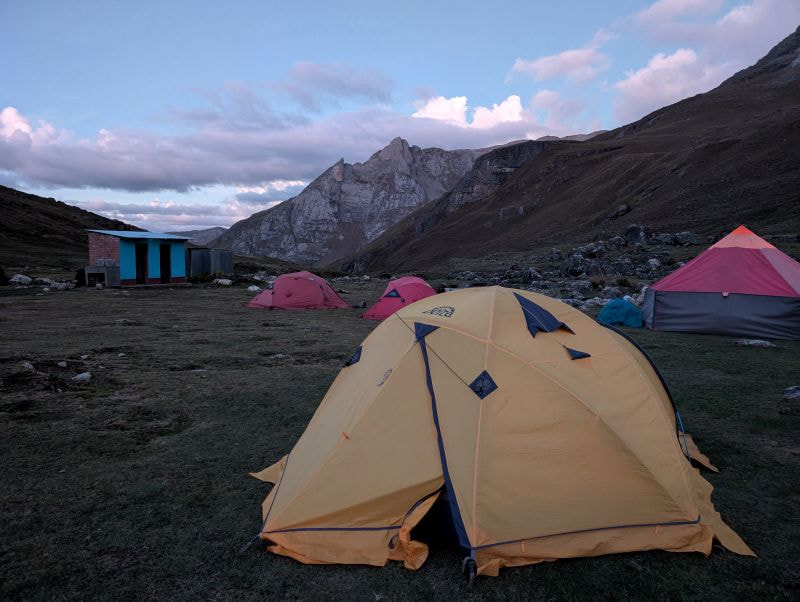
This camp was nice, had white noise, a crisp stream where you could soak you feet and we didn’t find any boggy areas to slip into. However, it was super busy when we were there and had a party atmosphere that we didn’t appreciate. We were told that there is an “easy” short version of the trek that uses this camp, which is why there were so many more people.
Camp 4:
- Approximate Location: -10.37536, -76.89243
- Altitude: 4535 m / 14,875 ft
- Views: Just ok
- Toilets: 2 flush toilets
- Animals: No livestock in camp
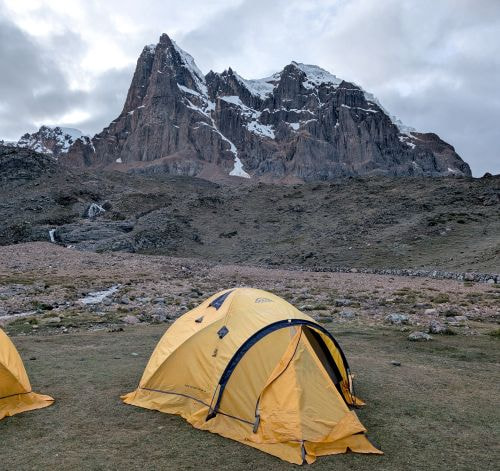
This camp had a little waterfall with the backdrop of a mountain and that stream provided some nice white noise, but also meandered through camp, making bathroom trips a bit of an adventure because you had to hop over it to get there and then avoid some marshy areas.
Camp 5:
- Approximate Location: -10.35884, -77.00024
- Altitude: 3535 m / 11,600 ft
- Views: None, town camp
- Toilets: 4 indoor flush toilets with lights & cold water sinks
- Animals: No livestock in camp
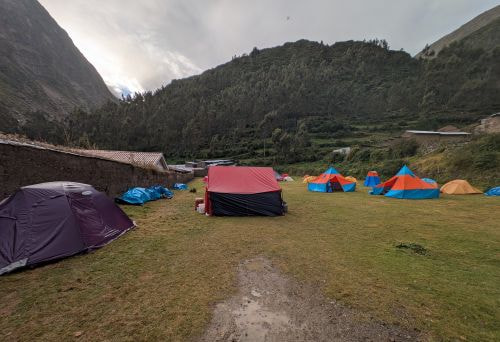
This camp was nestled in the middle of a town and had nice little luxuries like electric lights and stores up the hill where you could buy treats, snacks, and emergency supplies (including antibiotics, rehydration salts, ramen, pasta, raisin nut mix, tuna, 50g of dark chocolate for 15 PEN, and natural fruit/grain bars for 3 PEN). At camp there was also a woman selling wifi (10 PEN) access and we wanted to stay disconnected, but others who tried it said it worked. This was the one place on the trek where I saw a toilet with a toilet seat.
There was a woman knitting handmade good to sell, but sadly all she had were huge heavy socks that we had no use for. We were told that this town has a hotel and restaurant, but we were all set on those and the low altitude promised a warmer night, so we took the time to take a hat water bucket/pitcher shower in a shower tent our tour provided. All afternoon and into the evening there was a public speaker in the middle of town playing what might have been the radio, mostly consisting of music, making for a somewhat festive atmosphere that was an interested change of pace at camp.
Camp 6:
- Approximate Location: -10.27407, -76.99801
- Altitude: 4555 m / 14,940 ft
- Views: Some mountains but not very scenic
- Toilets: 2 flush toilets & a cold water sink
- Animals: Livestock in camp
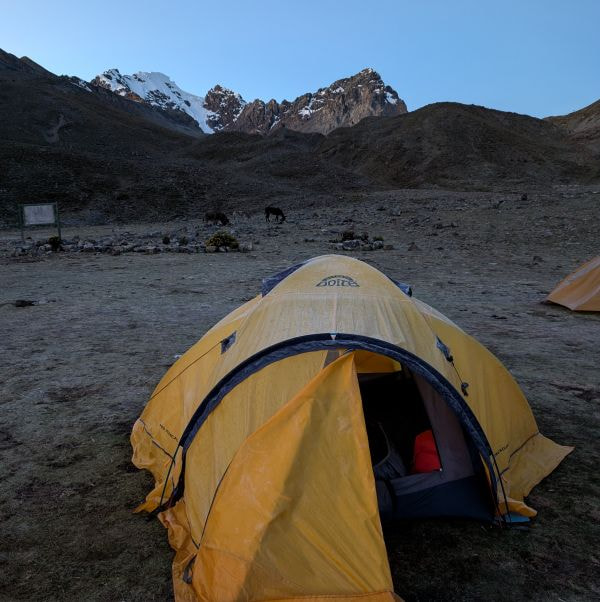
This was our highest camp and was very cold. There weren’t any wet areas and there weren’t many people, making for a quiet night, in stark contrast to our day in town. It got so cold over night that our tents were crunchy with frost and our camp dog pushed her way into the kitchen tent for a little relief.
Camp 7:
- Approximate Location: -10.23588, -76.96581
- Altitude: 4080 m / 13,400 ft
- Views: Stunning! Almost as good as Camp 2
- Toilets: 2 flush toilets & a cold water sink
- Animals: No livestock in camp
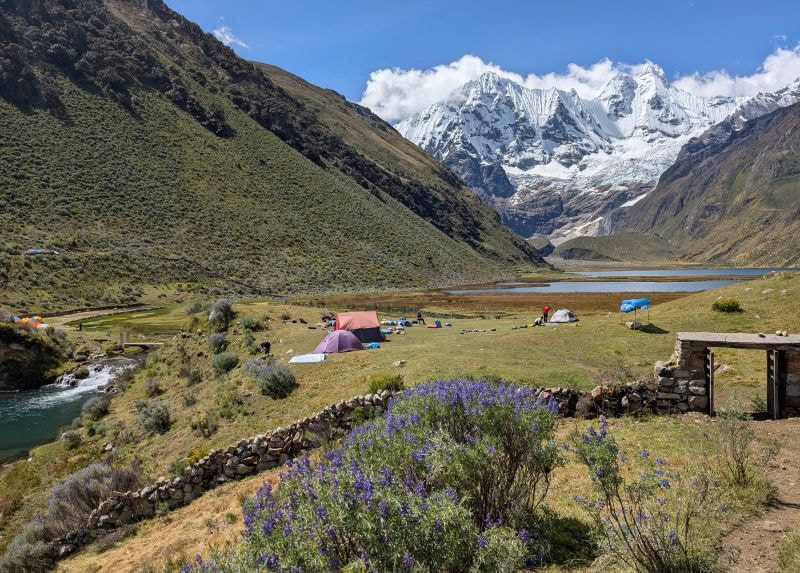
Our donkey drivers did an amazing job securing a prime spot for this night and we were right on the lake edge, sheltered from most of the wind. This camp had a lot of little spots and most groups had their own private camp. We could feel we were getting close to civilization because there was a house up the hill selling beer and wifi. This camp did have one less welcome resident, an overly playful large puppy, who was still nipping and trying to play when I got up to pee at 3AM.
Our Adventure:
We live in the mountains and have glaciers nearby, but this was next level scenery! We thoroughly enjoyed our trip and rank it up there in the best we have done. It was by no means easy, but Darwin, our guide, and his team were excellent at supporting us.
Merlin, our chef, worked magic out there. He cooked 3 meals a day and no two meals were the same. Every day lunch would be a meal he cooked that morning and packed to go, along with a thermos of hot coca tea. In the afternoon there would be a different snack with tea each day, then a dinner starting with a hot soup, then a main course, and finished with a dessert, which was often fruit ornately arranged. For the entrees we had a whole pan fried fish, a couple preparations of chicken, stuffed peppers, beef, and an amazing lentils with sausage.
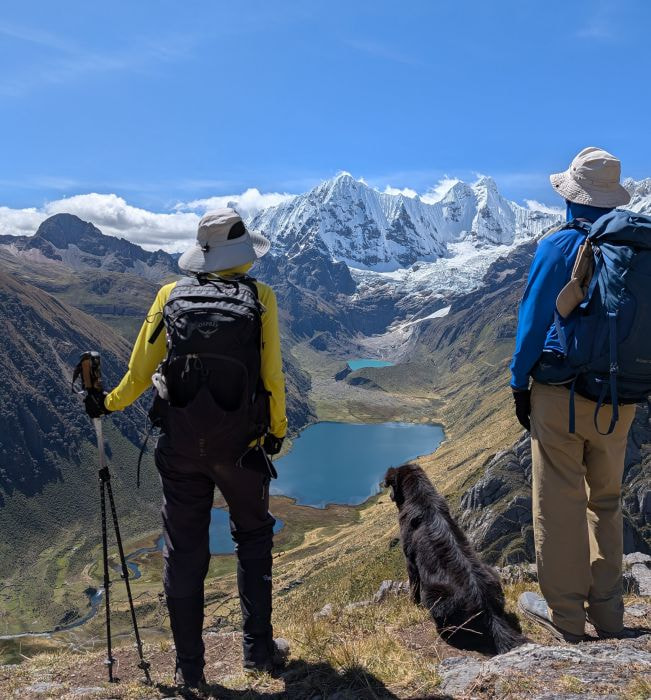
There are countless variations of this trek and every day we had options on what to do, so these stats are specifically for our trek as an general idea of what to train for, not necessarily what to expect.
| Day | ~Up | ~Down | ~Distance |
|---|---|---|---|
| 1 | 2300 ft (700 m) | 2000 ft (610 m) | 5.5 miles (9 km) |
| 2 | 2450 ft (750 m) | 2660 ft (810 m) | 6.8 miles (11 km) |
| 3 | 3080 ft (940 m) | 2510 ft (765 m) | 9.2 miles (15 km) |
| 4 | 3360 ft (1025 m) | 2740 ft (835 m) | 8.0 miles (13 km) |
| 5 | 2150 ft (655 m) | 5410 ft (1649 m) | 12 miles (19 km) |
| 6 | 4700 ft (1430 m) | 1220 ft (370 m) | 7.7 miles (12 km) |
| 7 | 1925 ft (590 m) | 3460 ft (1055 m) | 6.3 miles (10 km) |
| 8 | 1950 ft (595 m) | 3859 ft (1175 m) | 6.0 miles (10 km) |
To be continued…
What to Bring?
-
The Basics - Good to have on any hike
-
Footwear: We opted for waterproof hiking shoes(his/hers) and sandals to wear around camp with waterproof socks over liner socks. Waterproof socks are not good for hiking with here because they are nto breathable and your feet will overheat during the warm days.
-
Sleeping Bag: I love my Marmot Trestles Elite Eco 20° similar bag, but since it was not warm enough for this trek I supplemented it with a thermal liner and he rented a sleeping bag. On the cold nights both of us wore additional layers inside the sleeping bag.
-
Sleeping Pad: One of us used our inflatable one and one of us rented. There were both fine but we liked our’s better.
-
Food: They feed you really well but you can bring a couple small snacks or comfort treats like chocolate. We found that artificial sweeteners are common in pre-packaged food in Peru so if you are sensitive to those you should be careful.
-
Light: Make sure you pack a headlamp (plus batteries) and I like to have a small solar light to hang in our tent.
-
Water: On an assisted trek boiled water should be provided. We opted for hydration packs with backup collapsible water bottles. Some people find the hydration packs harder to use at high altitude.
-
Layers: We brought thermal underclothes for the nights, rain pants, rain coat that fit over everything as a shell, full zip fleece, warm puffy jacket.
-
Toilet supplies & quick drying washcloth
-
Hiking Poles: These are essential on a trip like this and have saved us from many potentially dangerous falls. We like Black Diamond Cork Grip Poles and Leki Cressida Poles.
-
Gloves: Warm waterproof gloves are important and a spare might be a good idea. I like to wear liner gloves year round when I am using poles because they keep my hands from chaffing and the worst sunburn I’ve ever had on my hands was on the back around where the pole strap goes.
-
Battery Packs: There is no charging and due to the weather solar charging may be limited so you will need to have an idea of your phone battery life in extreme battery saver mode and how many photos you take to get an idea of how much power you will need. We opted for a battery each (also the max airline allowance at the time) and a small spare 5000mAh backup to give us one more charge when our packs ran out. We also kept these batteries and our phones in our sleeping bags at night to keep them warm to help with battery life.
-
Clothes: 3 pairs of hiking socks, 2 pairs of hiking pants, 3 hooded sun shirts, and underwear.
Product Links: I am not sponsored by any of the products I link to. If you choose to make a purchase from one of the links of a product I listed or any other item a small percentage will go back to me to fund this website, at no additional cost to you. The products I link to are either ones I have used or similar if those are not available. Thank you for your support.
More?
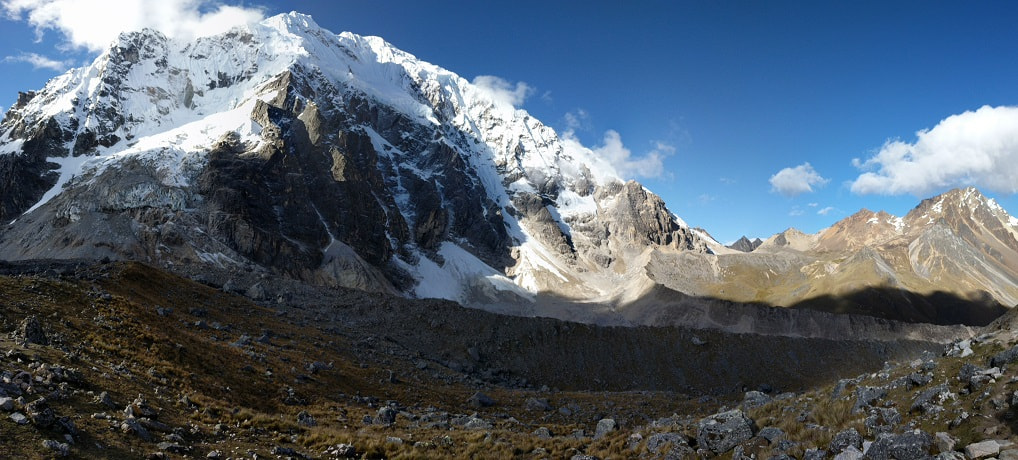
Travel part of the Inca Trail on the Salkantay Trek to Machu Picchu - Peru
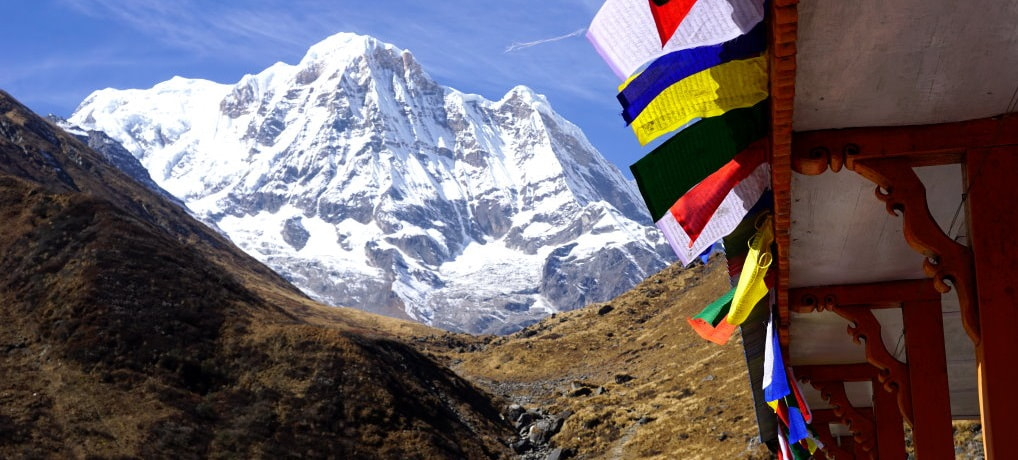
See more epic mountains on the Annapurna Base Camp Trek
Explore 6 Canadian National Parks in 1 Week Itinerary
Iceland see our full Trip Itinerary & Travel Budget.